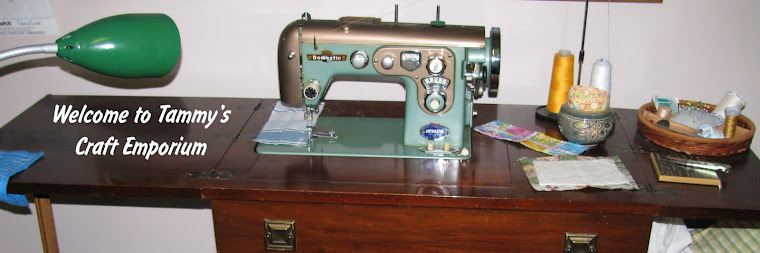
- I just started using this sewing machine that was my grandmother's and had looked unsuccessfully for a manual in the past--thanks! I'm a non-sewer guy but am mechanically skilled, nothing was very obvious except what I remembered from when I was a kid(the foot button the lever for the depressor foot). Now I am stuck. :) How is the bobbin threaded? I have it in the casing right, understand how that is re-installed, but am unclear on how to thread it back out/through the rest. (I was however able to see from your pics that it exits the plate in that center hole/slot.) I am trying to make a dog jacket w/nylon polyfill. :) Thanks in adv.












An excellent demonstration!
ReplyDeleteI hope his puppy coat turns out fantastic! I just finished making one for Penny :)
ReplyDeleteHi ,
ReplyDeleteI have the same machine and should point out that when threading machine.. when running the thread to the last guide (before threading needle, your photo #17) be sure the thread goes between the face cover and body and does not run across the plastic cover as it would in photo 17, this will wear grooves in the cover .
Remember Sophia Lauren was the spokes model for Necchi ... keep them pretty ;)
Hello Anonymous, Your are correct! The drawing in the manual Fig 4, does not show the thread passing through the slot between the front plate and the face of the machine. However, the instructions state that the thread must pass between the two as you have pointed out here. Thank you.
DeleteThank you for the info. I am looking at a Necchi Lelia 513 but it needs a bobbin case. Do you know where I could find one? Also how much should I pay for a 513? tHANKS
DeleteWell a Necchi Lelia that is not in working order is of course worth less than one that works. It has been my experience that parts are plentiful for vintage sewing machines. I would contact Ed Lamoureux he has a blog called vintage sewing machines located here http://sewing-machines.blogspot.ca/ and he is the Necchi expert. Hope this helps, good luck.
DeleteHello Tammy, Thanks for this blog, it's interesting and informative, especially for a beginner who is somewhat overwhelmed by the world of sewing. I have a question, and hope that maybe you can help. I inherited my grans Necchi Lelia 513, and have recently decided to start sewing. I'm a novice to say the least, but am determined to try to learn, I want to start making skirts. I have however encountered a problem. My cotton is looping alarmingly underneath, and I don't know what or how it happened. I threaded my bobbin when it ran out, it was a little full, but I removed some excess. I then put it back in, carried on and these loops just appeared, and it is getting worse and worse. My mother is better at sewing than me, and has adjusted tensions and so on, but nothing helps. There isn't a Necchi person anywhere near me, so I hope you can shed some light. Thanks so much, Mellissa Bushby (Nelspruit, South Africa).
ReplyDeleteOh dear Mellissa, I just read your comment today, more then 5 years since you wrote it. I'm sorry not sure how this happened. My guess is the machine is not threaded correctly. Generally looping at the bottom side means the top is not threaded right. However, I did have a machine looping like that once and when I checked the bobbin tension screw it was so loose it fell out in my hand. Hope this helps. Again I'm sorry for the tardy reply.
ReplyDelete